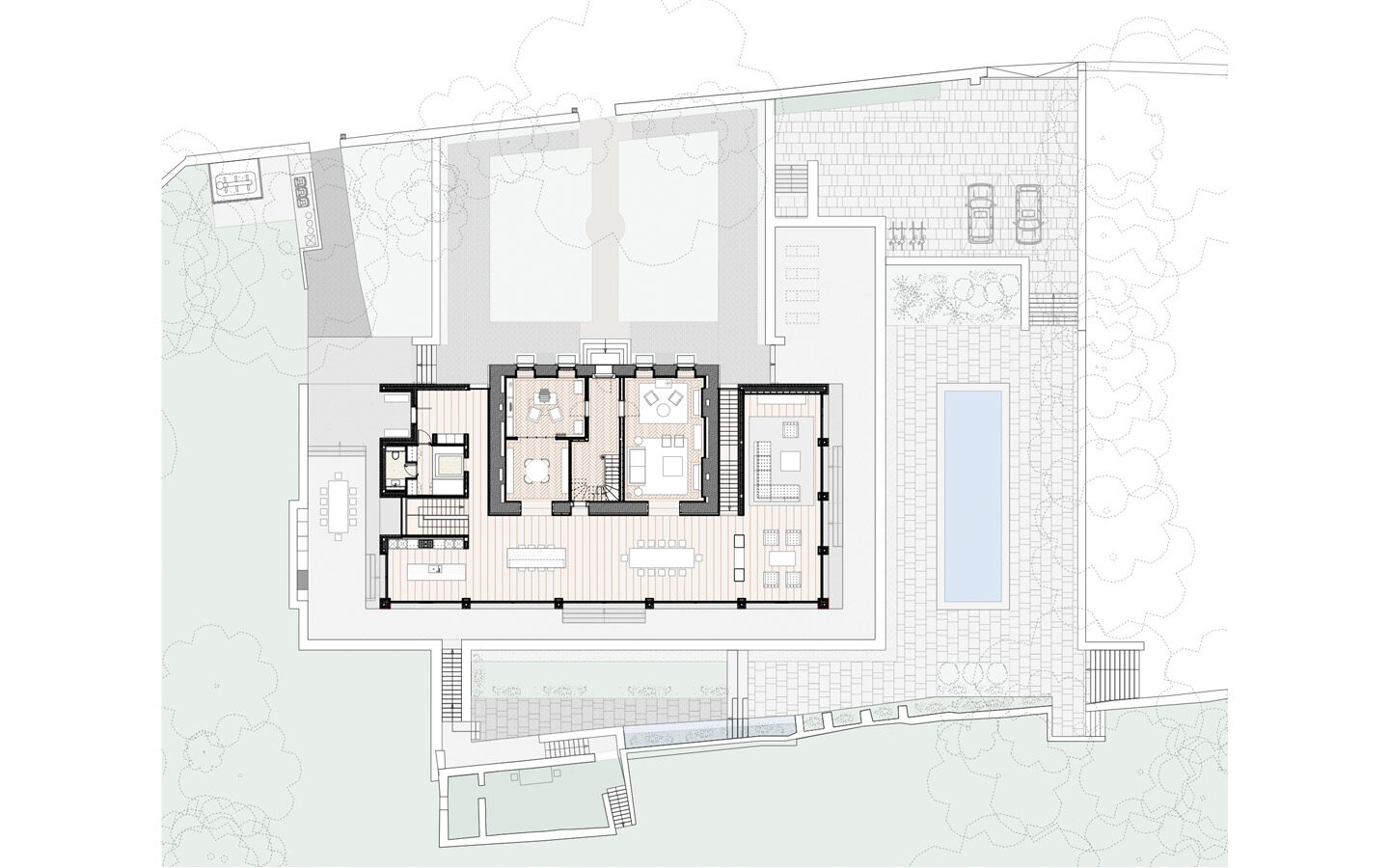
A decade ago, “the design” was often communicated through drawings, a few key details, and (if you were lucky) a set of visuals that helped clients imagine the finished space. Today, 3D modelling has shifted from being a presentation tool to becoming the design process itself—a working environment where spatial ideas, technical decisions, costs, coordination, and performance can be tested in parallel.
In architecture and interior design, that change is profound. A good 3D model is not just a representation of intent; it’s a decision-making framework. It allows teams to move faster, communicate more clearly, and reduce risk—while giving clients a better understanding of what they’re investing in, long before anything is built.
Below is an architect’s view of how 3D modelling is reshaping design—from early concept through construction and beyond.
Why 3D Modelling Matters Now
Modern projects are more complex. Homes integrate smarter systems, higher-performance envelopes, bespoke joinery, specialist lighting, and increasingly precise detailing. At the same time, expectations have risen: clients want certainty, programmes are tighter, and cost pressure rarely disappears.
3D modelling meets this moment because it compresses the feedback loop. Instead of waiting for “the next drawing issue” to discover a problem, teams can see conflicts and opportunities earlier—when changes are cheaper and easier.
From Renderings To BIM: When A Model Becomes A Shared Source Of Truth
Not all 3D models do the same job.
- Visualisation models are often built to communicate mood, materials, and atmosphere.
- BIM models (Building Information Modelling) carry geometry and data—so elements have meaning (what it is, where it is, what it’s made of, how it interfaces with other systems).
When a project uses BIM well, everyone works from aligned information rather than disconnected files. That’s why information management standards like ISO 19650 place emphasis on structured collaboration and shared data environments across an asset lifecycle.
In practice, that translates into fewer “version truths,” fewer surprises, and clearer decision-making.
Faster Iteration Without Losing Design Quality
One of the most immediate benefits of 3D modelling is speed with control. Architects can explore options—massing, layout, daylight openings, stair positions, joinery lines—while keeping geometry consistent.
This is especially powerful when paired with parametric approaches, where key relationships (like spacing, angles, radii, or heights) can be adjusted systematically rather than rebuilt from scratch. Parametric workflows are widely associated with faster exploration of variations and more controlled design development.
The result isn’t “more options for the sake of it.” It’s a more confident refinement process—one where design decisions are tested quickly and resolved earlier.
Better Coordination Through Clash Detection
If 3D modelling has a single superpower in technical delivery, it’s coordination. When architectural, structural, and MEP (mechanical, electrical, plumbing) information is brought together, teams can identify clashes before they become site problems.
Clash detection is repeatedly positioned as a practical advantage of BIM workflows because conflicts can be resolved digitally—reducing rework, delays, and cost impacts later.
This is not abstract. A recent open-access study reviewing BIM impacts across case studies reported average reductions in project timelines and costs, alongside fewer design errors and RFIs (requests for information), when BIM is properly adopted.
For clients, that typically means more predictability: fewer late-stage changes and a smoother path from design intent to built reality.
Clearer Client Communication And Faster Decisions
Even sophisticated clients can struggle to read 2D drawings. 3D models close that gap by making space legible: proportions, sightlines, circulation, and junctions become easier to understand.
This transforms meetings. Instead of talking around a plan, teams can talk through the space:
- How the kitchen relates to the garden
- What you see from the stair landing
- Where daylight falls in the morning
- How a material wraps a corner
- Whether storage feels integrated or intrusive
It also reduces ambiguity—helping clients make decisions earlier, with more confidence, and with fewer “I didn’t realise it would feel like that” moments later.
Immersive Review With AR And VR
As 3D modelling matures, it increasingly connects to immersive tools. AR (augmented reality) and mixed reality workflows allow teams and clients to experience scale and spatial relationships in a more intuitive way than screens alone.
Architecture media has highlighted how these tools can bridge the gap between drawings and lived experience—supporting design review, communication, and feedback.
For residential projects, immersive review can be especially helpful for:
- complex stair and double-height spaces
- joinery-heavy interiors
- lighting and ceiling coordination
- tight footprints where spatial efficiency matters
The goal is not spectacle. It’s clarity.
A Stronger Link Between Design And Construction
3D modelling also changes how drawings are produced. When documentation is extracted from a coordinated model, teams can maintain consistency between plans, elevations, sections, and schedules—reducing human error and repetitive drafting.
This aligns neatly with structured project frameworks like the RIBA Plan of Work, where information maturity increases stage by stage.
It also supports more modern construction approaches: prefabrication, design-for-manufacture, and bespoke elements that rely on dimensional accuracy. In those contexts, the model isn’t a “nice-to-have”—it becomes the backbone of buildability.
Performance-Led Design Becomes More Accessible
As modelling tools integrate analysis, architects can test performance considerations earlier:
- daylight distribution and glare risk
- Solar gain and shading logic
- ventilation pathways and comfort strategies
- energy modelling and envelope refinement
Even when specialist consultants are involved (as they should be for many analyses), 3D workflows make collaboration smoother because geometry and assumptions can be shared, reviewed, and refined with fewer translation errors.
From Model To Digital Twin: Extending Value Beyond Handover
The most forward-looking evolution is the move from static project models to living “digital twins.” A digital twin is commonly described as a virtual replica that can be linked with data—supporting monitoring, simulation, and optimisation over time.
In residential settings, this can support more intelligent operation—especially as homes become more systems-driven. The important point is conceptual: the model’s value doesn’t have to end at completion. It can continue to support maintenance, upgrades, and long-term stewardship.
3D Modelling Creates Confidence, Not Just Visuals
When used well, 3D modelling doesn’t replace architectural judgement—it amplifies it. It helps teams design with more precision, coordinate with fewer surprises, and communicate with greater clarity. It also supports the kind of calm, considered outcomes clients value most: spaces that feel resolved, buildable, and quietly intelligent.
At Found Associates, 3D modelling is treated as part of a holistic design process—supporting spatial quality, technical rigour, and a more confident journey from concept to completion.
FAQs related to transforming The Design Process
- What Is The Difference Between 3D Modelling And BIM?
3D modelling describes geometry and form; BIM typically includes geometry plus data, enabling coordinated information management and collaboration. - How Does 3D Modelling Reduce Construction Problems?
Coordinated models enable clash detection, helping teams identify conflicts between disciplines before work starts on site. - Does BIM Actually Save Time And Cost?
Case-study research indicates BIM adoption can reduce timelines and costs and cut design errors and RFIs when implemented effectively. - How Do AR And VR Help In The Design Process?
Immersive tools can make scale and spatial relationships easier to understand, improving design review and stakeholder communication. - What Is A Digital Twin In Building Design?
A digital twin is generally described as a virtual replica of a physical asset linked with data to support monitoring, simulation, and optimisation across the lifecycle.
References
- https://foundassociates.com/
Found Associates (Official Site) - https://www.riba.org/work/insights-and-resources/riba-plan-of-work/
RIBA Plan Of Work - https://www.bsigroup.com/en-US/products-and-services/standards/iso-19650-building-information-modeling-bim/
BSI: ISO 19650 And BIM Information Management - https://www.iso.org/standard/68078.html
ISO 19650-1:2018 (Concepts And Principles) - https://damassets.autodesk.net/content/dam/autodesk/www/pdfs/common-data-environment-iso-19650-ebook-en.pdf
Autodesk: ISO 19650 And Common Data Environments (PDF) - https://link.springer.com/article/10.1007/s43939-025-00200-2
Springer (2025): Impact Of BIM On Project Time And Cost (Open Access) - https://www.autodesk.com/blogs/construction/bim-clash-detection/
Autodesk: BIM Clash Detection Overview - https://matterport.com/blog/bim-clash-detection
Matterport: BIM Clash Detection Guidance - https://www.archdaily.com/1029744/beyond-the-drawing-board-how-augmented-reality-is-reshaping-architectural-design-review
ArchDaily: Mixed Reality And Architectural Design Review - https://www.dustyrobotics.com/articles/a-complete-guide-to-digital-twins-in-construction
Dusty Robotics: Digital Twins In Construction Explained - https://www.sciencedirect.com/science/article/pii/S0926580525003176
ScienceDirect: BIM-Enabled Digital Twin For Building Operations (Research Article)